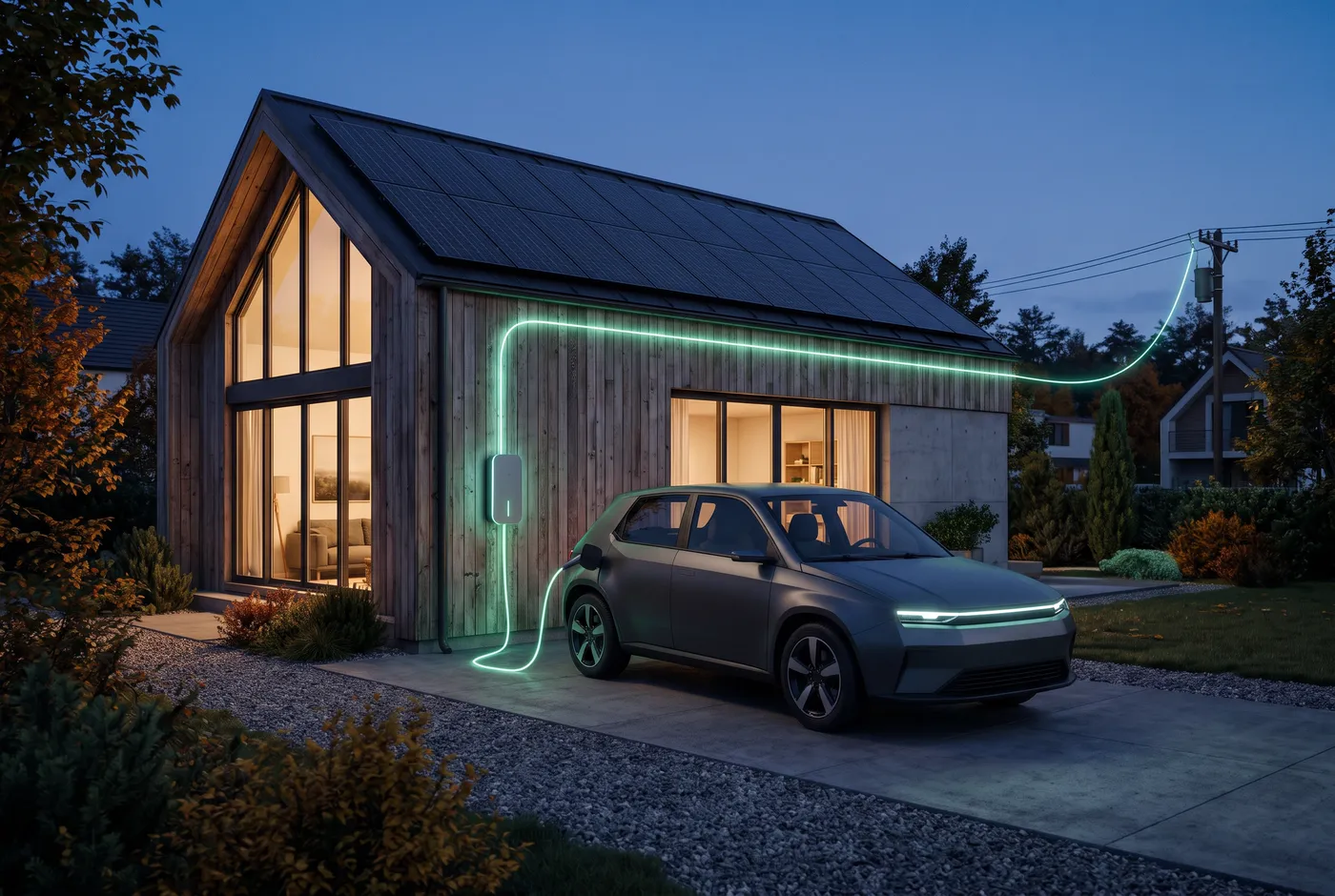

An electric car carries a large energy store and is parked most of the time. So the idea of not only filling this store but also discharging it when needed is an obvious one. That is exactly what bidirectional charging means: electricity flows in both directions. Depending on where it flows back to, there are three applications.
V2L: power for devices
Vehicle-to-load is the simplest form. The car supplies alternating current via a socket in the cabin or an adapter on the charging port. You can use it to run tools, a laptop, lighting or the coffee machine when camping. The power is enough for typical household appliances, but not for an entire house. No additional infrastructure is needed, and the grid is not involved. V2L is already available as standard or as an option on numerous models. Many vehicles let you set a minimum charge level at which discharging stops, so enough range remains for the journey home.
V2H: the car powers the house
With vehicle-to-home, the car feeds electricity into the household circuit. During the day it charges, for example, with solar power from your own roof; in the evening it covers the household’s consumption. This increases self-consumption, and less electricity has to be bought in. Depending on the design, V2H can also serve as a backup power supply, provided the house is safely disconnected from the public grid.
This takes more than a suitable car. You need a bidirectional wallbox, an energy management system that coordinates generation, consumption and charge level, and professional integration into the home installation. Because the car then acts like a generating plant, the grid operator must be involved.
V2G: storage for the power grid
Vehicle-to-grid goes one step further. The car feeds electricity into the public grid when it is scarce or expensive, and charges when plenty of wind and solar power is available. For the grid, the individual battery matters less than the quantity: a pool of many vehicles can shift load flexibly, much like a large stationary storage system. This could earn owners a payment. For it to work, metering, communication and billing must interact alongside the car and wallbox: a smart metering system, a tariff or service provider that controls charging and discharging, and clear rules on grid fees and levies on stored electricity.
What the technology needs to do
- Vehicle: the manufacturer must approve discharging, both technically and in the warranty terms. Some manufacturers limit the amount of energy or the applications.
- AC or DC: with the DC approach the wallbox converts the electricity; with the AC approach a bidirectional on-board charger in the car does this.
- Communication: the car and wallbox must be able to talk to each other. For CCS vehicles this is described by the ISO 15118-20 standard; the Japanese CHAdeMO system has supported bidirectional charging for longer.
- Grid connection: feeding power back requires coordination with the grid operator and protection technology in line with the technical connection rules.
Where development stands
V2L is ready for everyday use. V2H is available in initial product combinations of car, wallbox and energy management, often only for certain models. In Germany, V2G is still mostly limited to pilot projects and early offers. The main open issues are standards, metering concepts and billing. An intermediate step is smart charging: the car charges preferably when electricity is cheap or plentiful, but gives nothing back. That already works today with many wallboxes and dynamic electricity tariffs. Anyone choosing a car or wallbox today should ask specifically about approval for bidirectional charging and have the supported applications confirmed in writing. The basics of installation are covered in the article A wallbox at home.
Before buying a bidirectional wallbox, check whether your exact vehicle model is approved. Compatibility is currently often model specific.
Frequently asked questions
Does bidirectional charging age the battery faster?
Every additional cycle puts some strain on the battery. How much depends on the amount of energy, the power and the charge range used. What matters is that the manufacturer approves the use and that the battery warranty remains unaffected.
Can every electric car charge bidirectionally?
No. Many models support V2L at most. For V2H and V2G, the vehicle, its software and the wallbox must be designed and approved for it.
Does V2H work during a power cut?
Only if the system has been planned for it. The house must be safely disconnected from the public grid so that no electricity flows back into the failed grid.