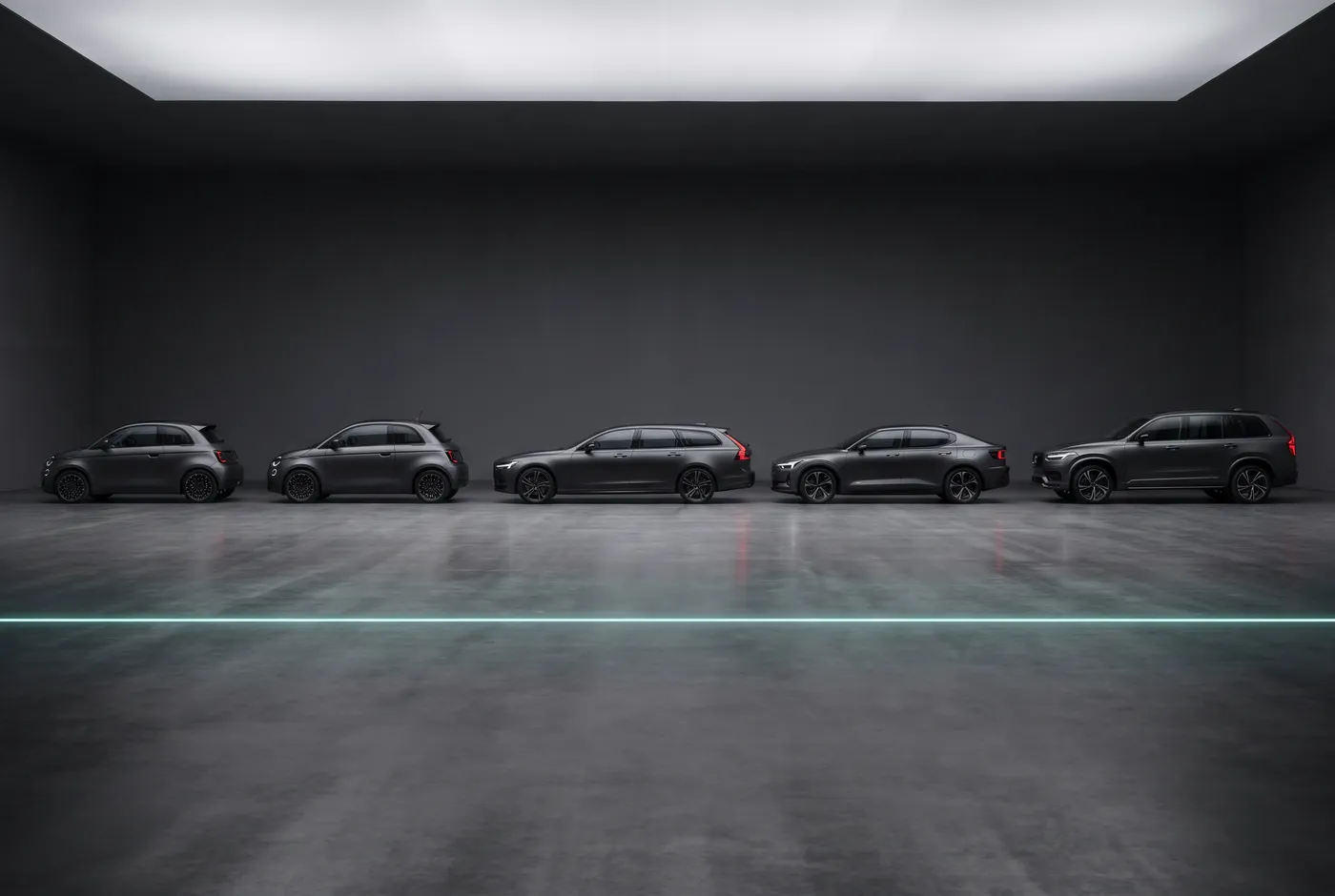

In car showrooms, test reports and registration statistics, the same terms crop up, but they do not always mean the same thing. The most important key to understanding them: there are two different ways of classifying cars. The segment describes a model’s size, positioning and purpose. The body style describes how it is built. So a model can belong to the mid-size class and be offered both as a saloon and as an estate.
The segments of the Kraftfahrt-Bundesamt
For its statistics, Germany’s Federal Motor Transport Authority (Kraftfahrt-Bundesamt, KBA) assigns every car model series to a segment. This is based on visual, technical and market-related characteristics such as dimensions, engine power, space and price level. There is no rigid formula based on length or price. The segments at a glance:
- Minis and small cars: short, nimble city cars and classic entry-level models.
- Compact class: the versatile middle ground, often with a hatchback, as an all-rounder for everyday life and holidays.
- Mid-size class, upper mid-size class and luxury class: more length, space and comfort, usually more powerful engines, up to prestigious chauffeur-driven cars.
- SUVs and off-roaders: taller vehicles with a raised seating position.
- Sports cars: models designed for performance and looks, often as a coupé or convertible.
- Mini MPVs and large MPVs: lots of interior space, flexible seating, a high roofline.
- Utilities and motorhomes: passenger cars derived from commercial vehicles, such as van or pick-up variants, and motorhomes for travel.
There is also the residual group “Other” for vehicles that cannot be assigned to any segment, such as very old models. The classification mainly serves statistical purposes: it shows which types of vehicle are registered and how often. It has nothing to do with the vehicle category in the registration documents, where “M1”, for example, stands for passenger car.
SUV, off-roader and crossover
The KBA draws the line between SUV and off-roader formally: off-roaders are models type-approved as off-road vehicles of category M1G. To qualify, they must meet requirements on drive, climbing ability and ground clearance, among other things. Models with an off-road look but without this approval count as SUVs. Many SUVs have front-wheel drive only and are designed mainly for paved roads.
Crossover is not an official segment but a marketing term. It usually refers to vehicles that combine elements of different classes, such as a raised compact model with SUV styling or an SUV with a coupé-like sloping roof. In the statistics they end up in the appropriate segment, often among the SUVs. Terms such as “SUV coupé” or “shooting brake” are similarly vague and describe design directions rather than fixed categories.
Body styles: saloon, estate and others
Regardless of segment, the body style describes the construction. A saloon in the strict sense has a notchback with a separate boot lid; in everyday speech the term is also used more loosely for closed cars in general. The hatchback has a large tailgate that opens together with the rear window. The estate extends the roof all the way to the rear, offering more luggage space. Then there are the coupé with a low roofline, the convertible with an open top and the MPV with a tall, box-shaped interior. Electric cars blur some boundaries, because other proportions are possible without an engine block and transmission tunnel. When choosing, it helps to ask what regularly comes along: for a pushchair, a dog or sports equipment, the shape of the boot is often more important than the class.
The European classification from A to F
Internationally, you often come across a letter classification that goes back to the European Commission. It serves only as a rough guide: A stands for mini cars, B for small cars, C for the compact class, D for the mid-size class, E for the upper mid-size class and F for the luxury class. SUVs, MPVs and sports cars are given their own letters. However, manufacturers and media do not use the abbreviations consistently. When comparing models, it is therefore better to look at concrete values such as length, boot volume and interior dimensions.
In everyday life, dimensions count for more than class names. Check the length, and the width including door mirrors, against your parking space or garage before you decide.
Frequently asked questions
Is an SUV automatically suitable for off-road driving?
No. Many SUVs have front-wheel drive only and are designed for paved roads. The KBA only lists models type-approved as off-road vehicles (M1G) as off-roaders.
Who decides which segment a car belongs to?
For the German registration statistics, the Kraftfahrt-Bundesamt assigns model series according to visual, technical and market-related characteristics. Manufacturers sometimes use their own designations in advertising.
Is an estate a vehicle class of its own?
No. Estate is a body style. There are estates from small cars through the compact and mid-size classes up to higher segments.